





Introduction:
Since the development of human civilization, humans have been inventing devices inspired by human and animal anatomy. For example, cameras that replicate the eyes, smoke detection sensors that replicate the nose, and microphones that replicate the principles of human ears. The Doppler effect was influenced by bats. There is a conceptual connection between the workings of the heart and an engine, as well as between the diaphragm in speakers and the larynx. However, there has been a gap between these sensors and how humans naturally use their own sensors, especially when it comes to intelligence. These inventions simply followed instructions without the ability to make decisions. Then, humans decided to bring intelligence to machines, which is now widely known as Artificial Intelligence (AI). Although we often refer to the processor as the brain of a computer, it is not quite the same. To make a processor process like a brain, it requires a key component: neurons. Before diving into the "how," let's first understand the "what." The term AI is commonly seen and heard everywhere. 8 out of 10 electronic gadgets you buy now have AI. Along with AI, we also hear terms like
- ML (Machine Learning)
- DL (Deep Learning)
- Generative AI
and also we will understand supervised vs un-supervised learning. This article aims to provide a clear understanding of what these terms mean and to normalize their usage. Let me interest you with a story.
Raising a child
I raised a hypothetical child. When he turned 4 years old, I decided to teach him some basic things, like the English alphabet. I gave him a book with the English alphabet, a notebook, and a pencil for writing. I expected him to go through the book and write down the alphabets. But you know what? He didn't even know what those symbols represented.
Machine learning
So, I sat with him, held his hand with the pencil, and started to write the letter "A," while also telling him that this is "A" and how it sounds. This process is called teaching, and the child is learning. I provided him with information, such as symbols and sounds, and he learned from it. If the same process is done with a machine (computer), it is called Machine Learning. Therefore, I can now say that: Machine Learning is a subset of AI. It involves developing algorithms that enable machines to learn from data and improve their performance over time without being explicitly programmed. Now, I have trained that boy to read and write English alphabets. So, the next time he sees an alphabet or a word, he can individually identify the characters in it.
Supervised learning
If you see the whole process. I sat down with him for weeks so that he could learn. I was supervising him all along so that he could learn. So we can say that I trained the boy to learn alphabets by continuously supervising him. So
In supervised learning, the algorithm is trained on a labeled dataset, meaning it learns from input-output pairs. The goal is to make predictions or classify new, unseen data based on what it learned during training.
Un-supervised learning
Years went by, and he turned 15. One day, while we were watching TV, he was flipping through channels and stopped at a French movie that had no subtitles. He began to watch and started laughing. I sat there, completely clueless about what they were saying. I had no idea that he knew French. When I asked him about it, he told me that he had gone to a library and started learning French on his own. I felt proud of him for not needing my supervision to learn something. He learned it unsupervised. So
Unsupervised learning, on the other hand, deals with unlabeled data. The algorithm explores the data's structure and patterns without predefined outputs. Clustering and dimensionality reduction are common tasks in unsupervised learning.
Deep learning
The boy was able to learn something new since he knows how one could learn new stuffs. He resembled and made new connection in his neurons by learning a new thing. Everytime you learn something, your neurons in the brain resembles its connection. So
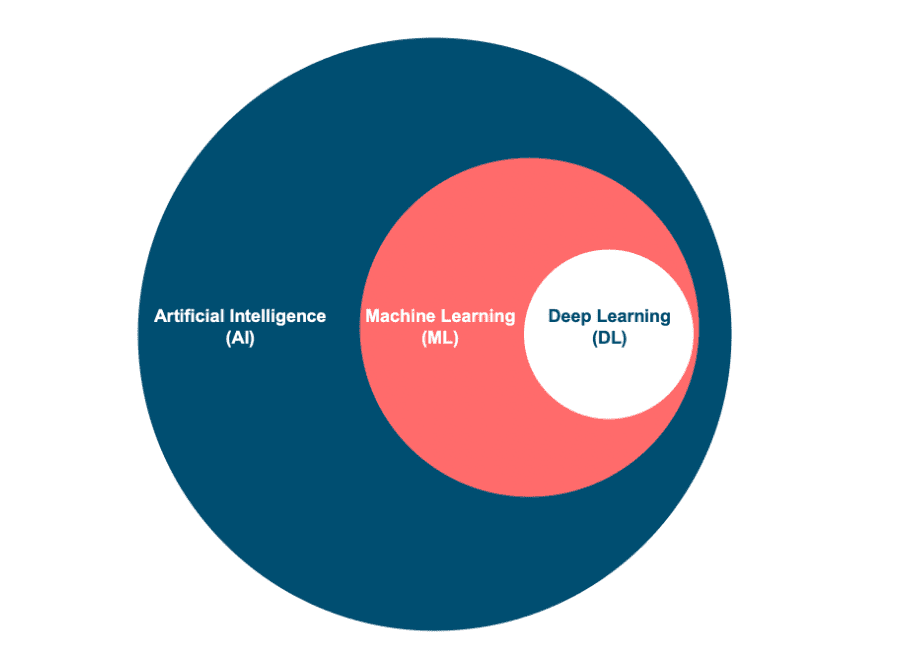
Deep Learning (DL) is a subset of Machine Learning that focuses on neural networks, particularly deep neural networks with multiple layers. It's inspired by the structure and function of the human brain and is particularly effective in tasks like image and speech recognition.
Artificial Intelligence
Years went by, and he turned 25. During this time, he acquired knowledge in various fields such as languages, math, programming, and sports. Now, he possesses a wealth of knowledge. Eventually, he decided to put his knowledge to use by building something. He attended an interview where he was presented with a problem: designing a complex traffic signal system. He utilized the matrices he had learned in math to design a sophisticated traffic signal intersection. He applied his knowledge in an intelligent manner. When this process is done artificially, using machines, it is referred to as Artificial Intelligence.
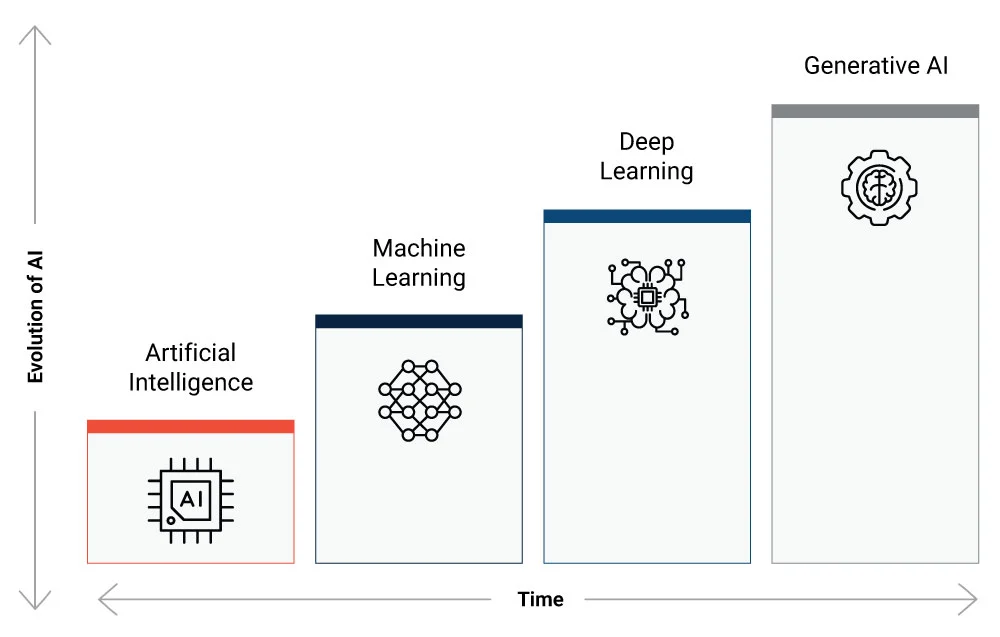
Artificial Intelligence (AI) is the broader concept, aiming to create machines capable of performing tasks that typically require human intelligence. It encompasses various techniques, including Machine Learning (ML).
Generative AI
So it is clear that Artificial Intelligence (AI) is the overarching field that encompasses various technologies aiming to create intelligent machines capable of human-like tasks.
Generative Artificial Intelligence refers to a specific subset within AI. It involves systems that can generate new, often creative, content. This could include generating text, images, or even music.
In short, Generative AI is a type or application of AI, emphasizing its ability to create new and original content.
with that been said:
Building a AI is like rising a child. Is it hard or easy? You already know the answer if you have raised a child. If not, Ask you parents.
Summary
To summarize AI,ML,DL,GENAI, we can look into the below image. There is a tool called magic eraser from google which is used to remove a selected thing on a photo.
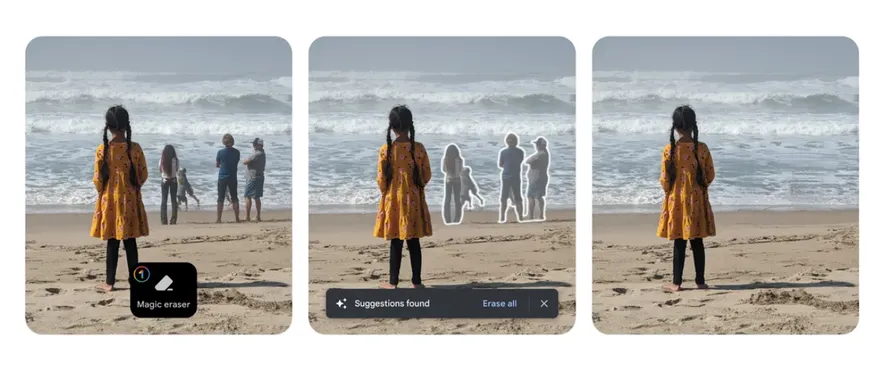
Step1:
First you select an image to perform the erasing process.
Step2:
The tool automatically identifies the objects present in the image using AI. It has undergone machine learning techniques to enable it to identify various objects such as humans, animals, vehicles, food, and more. Google claims that it can identify a billion items, so the model is trained to recognize a vast number of objects. Additionally, the tool's engine can now learn to identify objects through unsupervised learning, a training process commonly used in machine learning.
Step3:
When we click erase, it erases the selected objects from the picture. You can see that it not only removes the image, but also generated appropriate background. in our case, it removes the people and replaced with the same beach and sand background. This is generated by the AI model and called as Generative AI. The model learns in real time, trains itself and also generates an output. Lets look this sentence little closer.
The model learns in real-time, trains itself - ML,DL and AI
and also generates an output - Generative AI
Conclusion:
I hope you understood.


